
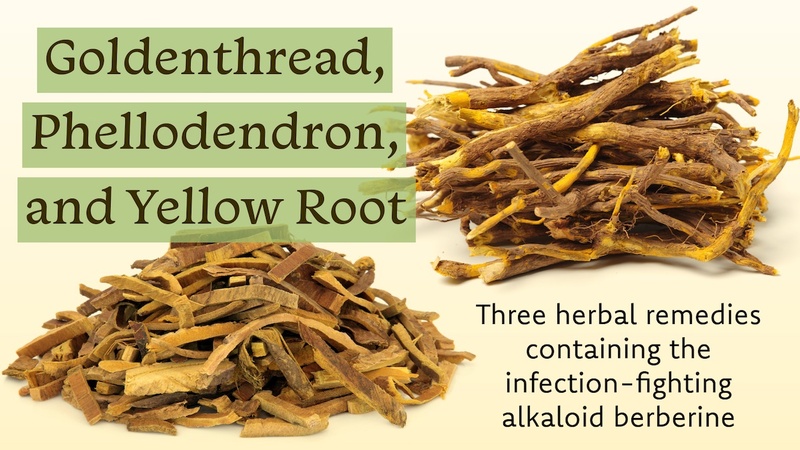
When you study herbal medicine, you find that people around the world have used plants for similar purposes, showing consistency in how herbs are used across cultures. And to illustrate that, I’m going to write about two herbs used in traditional Chinese medicine (TCM) that also contain berberine—Goldenthread and amur cork tree bark. I’m also going to briefly mention a third plant that contains berberine, found in the Southern United States—yellow root.
Coptis or Goldenthread
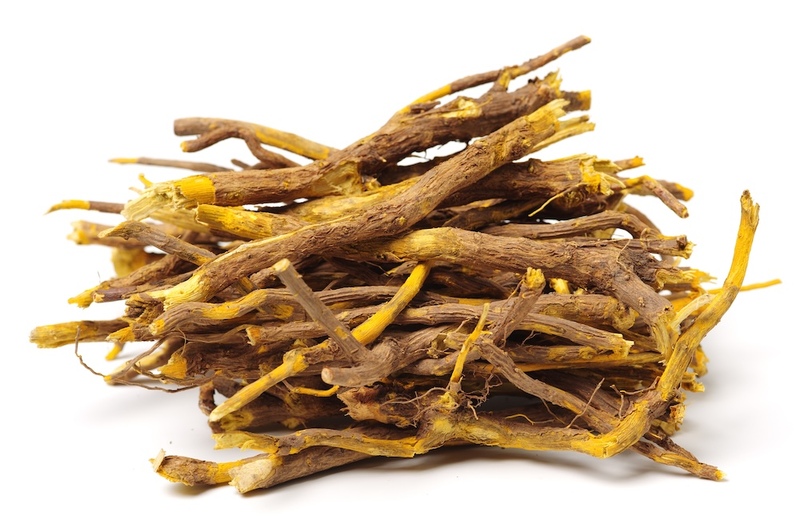 Chinese goldenthread, also known by its Latin name Coptis, is one of the plants used in TCM that contains berberine. It is used in similar ways to Western herbs that contain this alkaloid, such as goldenseal and barberry. In TCM terms, coptis clears “damp heat,” that is, inflammation associated with fluid retention. It also clears toxins from the system, removing sources of “toxic fire.” In other words, clears inflammation and fever caused by infection or toxins. In Western terms, we would say coptis is detoxifying, anti-inflammatory, and antibacterial.
Coptis is a good alternative to goldenseal for correcting intestinal dysbiosis, characterized by belching, bad breath, and an overgrowth of bacteria in the small intestines. Like goldenseal, it is also useful for inflammatory bowel disorders, colitis, and diarrhea, especially diarrhea associated with GI tract infections.
Coptis is good for urinary tract infections. It’s also a choloagogue and blood purifier and has been used both topically and internally to help clear up skin diseases like dermatitis and eczema. In addition, it is helpful topically for skin ulcers; something goldenseal is also useful for healing.
The Chinese dosage is 2-10 grams, taken as a decoction, which is equivalent to four to twenty 500-milligram capsules. It is commonly found in formulas used to reduce inflammation and fight infections. Because it is cooling and drying, it is contraindicated when someone is cold, deficient, and dehydrated.
Chinese goldenthread (Coptis chinensis) is not the only species in the Coptis genus that has been used medicinally. C. japonica, Japanese goldenthread, is used in much the same way. And, there is a species of goldenthread that grows in North America and Asia, threeleaf goldenthread (C. trifolia), that has also been used medicinally. The rhizome of C. trifolia was used by several native American tribes to treat stomach cramps, worms, vomiting, mouth sores, and sore throat. They also gave it as a tea to babies who were throwing up or had sore throats. It was also used to treat jaundice.
Amur Cork Tree bark
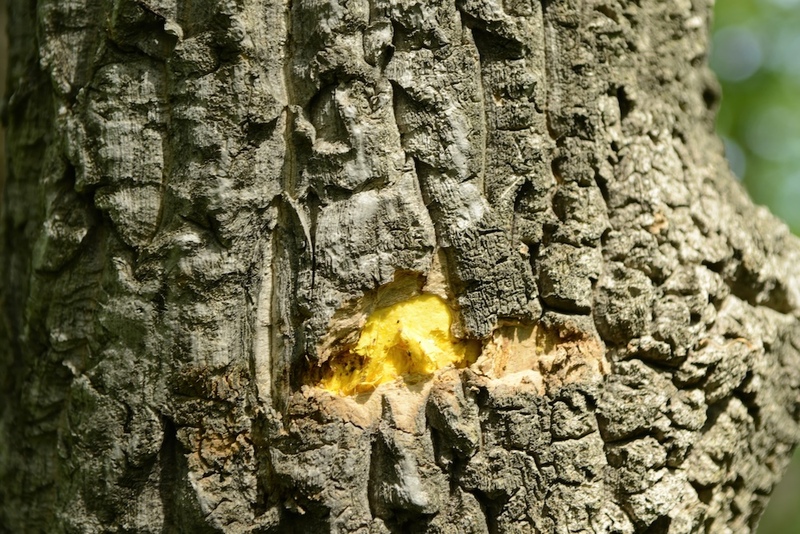 A tree in the rose family, Phellodendron amurense, is used to clear damp heat in traditional Chinese medicine. The Latin name, Phellodendron, should not be confused with philodendron, the popular but poisonous house plant.
Amur cork tree bark also contains the alkaloid berberine. It is the same alkaloid found in many Western herbs used to treat infections, such as goldenseal, Oregon grape, and barberry, and is used in traditional Chinese medicine for similar purposes. It is a detoxifying agent that helps reduce inflammation and clear up bacterial infections. Like other herbs with berberine, it also stimulates the gallbladder and digestive secretions and can help correct intestinal dysbiosis.
It is also used topically for boils, abscesses, and eczema. A COX-2 inhibitor called Nexutrine has been extracted from the bark, so it also has some analgesic (pain-relieving) properties.
In TCM, the typical dose is 5 grams per day taken in a decoction, but the dose can range from 3 to 10 grams. In capsule form, 5 grams would be ten 500 mg capsules, so a good dose for capsules would 3 to 5 grams or 2-3 capsules three times a day. Extracts of the bark can be found in formulas for reducing pain and relieving inflammation. In TCM, it is contraindicated for weakness and cold in the spleen and stomach.
Yellow Root
When I was at an AHG conference in Atlanta, I found some yellow root for sale at a local grocery store. I bought some and found it helpful for canker sores, which I typically treat with goldenseal. It has a very similar taste, too. It’s a popular herb in the South, but not well-known in the commercial herb trade. I find this a shame because goldenseal is endangered, and yellow root is plentiful. I think it is also a better substitute for goldenseal than Oregon grape or barberry. If you want to learn more about this remedy, watch the interview I did with Southern folk herbalist Phyllis Light.
If you want to learn more about the benefits of berberine, read my article The Evidence for Berberine. I’ve previously written articles about other herbs that contain berberine: barberry, goldenseal, and Oregon grape.
Steven's Articles
May
-

-
Cress: Three Overlooked Cruciferous Vegetables
Watercress, Garden Cress, and Pennycress have…
-

-
Cruciferous Vegetables
The Health Benefits of Broccoli, Cauliflower,…
April
-

-
Kale Chips
A fun way to eat your leafy, green vegetables
-

-
Ligustrum (Glossy Privet Fruits)
Ligustrum is a liver and kidney tonic that strengthens…
-

-
Bupleurum
An important Chinese herb for supporting the liver…
March
-

-
N-Acetylcysteine
An amino acid-based supplement for liver, eye,…
-

-
The Effects of Tryptophan on Health and Mood
L-Tryptophan and 5-HTP are important precursors…
-

-
The Exotic Scent of Ylang Ylang
Promoting sensual feelings, relaxing the nerves,…
-

-
The Uplifting Fragrance of Jasmine
Jasmine lifts depression, aids self-confidence,…
February
-

-
Reishi (Ganoderma) Mushroom
A TCM remedy for calming the shen (spirit), balancing…
-

-
Eucommia Bark
A superior tonic that promotes kidney, structural,…
January
-

-
Goldenthread, Phellodendron, and Yellow Root
Three herbal remedies containing the infection-fighting…
-

-
Teasel
A traditional herb for healing bones and joints…
-

-
Barberry and Healthy Personal Boundaries
A thorny shrub for fighting infections and supporting…
December
-

-
The Evidence for Berberine
A yellow alkaloid found in traditional infection-fighting…

Steven Horne is an herbalist and healer who focuses on teaching others how they can start building health and stop treating disease.
-
-
Cress: Three Overlooked Cruciferous Vegetables
Watercress, Garden Cress, and Pennycress have valuable… | May 18, 2026
-
-
-
Cruciferous Vegetables
The Health Benefits of Broccoli, Cauliflower, Kale,… | May 6, 2026
-
-
-
Kale Chips
A fun way to eat your leafy, green vegetables | April 30, 2026
-
-
-
Ligustrum (Glossy Privet Fruits)
Ligustrum is a liver and kidney tonic that strengthens… | April 28, 2026
-
-
-
Bupleurum
An important Chinese herb for supporting the liver… | April 6, 2026
-
- More Articles
- Using Foods as MedicinesMay 26, 2026 6:00 pm MTMember webinar
- The Medicinal Kit in Your Kitchen CabinetJune 30, 2026 6:00 pm MTMember webinar
- Herbs & HomeopathyJuly 28, 2026 6:00 pm MTMember webinar
- The Amazing Benefits of AdaptogensAugust 25, 2026 6:00 pm MTMember webinar
- Silicon: The Overlooked NutrientSeptember 29, 2026 6:00 pm MTMember webinar
- More Webinars & Classes
Useful Links
Contact Us
Email: treelite@treelite.com
Steven Horne Creations
PO Box 1172
St. George, UT 84771
2026 © Steven Horne Creations, LLC. All Rights Reserved.