
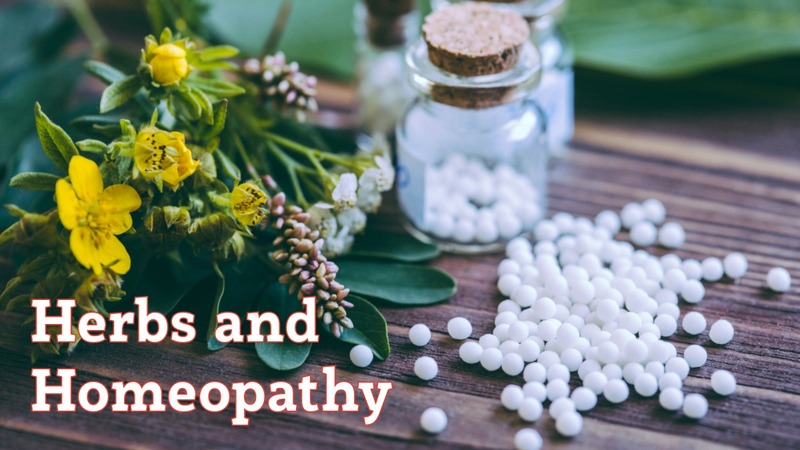
Homeopathy is a system of medicine based on the idea that "like cures like." Essentially, homeopathy uses a remedy that produces similar symptoms to the disease being treated. This foundational principle of homeopathy is in direct opposition to modern allopathic medicine, which uses remedies that counteract or suppress symptoms. Herbalism and naturopathy use remedies both ways.
Another founding idea of homeopathy is the concept that a small dose will have the opposite effect as a large dose. This can actually be seen in the action of many herbal remedies. A drop of lobelia extract, for example, can ease nausea, while a larger dose causes nausea and vomiting. So, the indications for homeopathic remedies are determined by having a group of people take a large dose of something and reporting the symptoms that develop. A diluted dose of this same remedy is used to relieve the symptoms that the remedy caused.
What makes homeopathy different from herbal medicine, however, is that the doses are repeatedly diluted. A one-to-ten dilution is an X dilution, while a one-to-one-hundred dilution is a C dilution. This is based on the Roman numeric system, which represents ten as an X and 100 as a C. Thus, a 6x homeopathic remedy has been diluted 1 part to 10 parts six times. A 30c homeopathic remedy has been diluted 1 part to 100 parts thirty times.
One of the major objections to homeopathy is the idea that the more the remedy is diluted, the stronger it becomes. This is especially controversial because after a certain point, the diluted remedy doesn't contain even one molecule of the original remedy. But the fact that homeopathic remedies do work, something that has been shown in double-blind studies, suggests that homeopathic remedies are energetic, not chemical in nature.
If this is confusing, don't worry. We'll discuss all of this in the webinar.
However, that will not be the focus of the webinar. What we'll be doing is focusing on some popular homeopathic remedies made from herbs. In particular, we'll focus on homeopathic remedies made from herbs that would be poisonous if ingested in large amounts, but are perfectly safe in homeopathic form. These include herbs like arnica, belladonna, foxglove, gelsemium, henbane, monkshood, poison nut (nux vomica), poison ivy, and others. We'll cover some of the most popular homeopathic remedies from plants that aren't toxic, such as calendula, chamomile, St. John's wort (hypericum), nettles, and coffee, which will provide insights into these commonly used plants. Join us for this fascinating discussion of homeopathy and herbalism.
Become a Member to Watch Herbs & Homeopathy
Steven Horne's member program includes monthly training in natural healing techniques using herbs, nutrition, dietary supplements and lifestyle changes as well as emotional healing and other holistic techniques through our webinars, including Herbs & Homeopathy.
Steven has helped thousands of people succeed with herbs and natural healing. Sign up today and gain access to his powerful, practical insights to improve your health using herbs and natural healing and to help others do the same.
Steven Horne's Member Program Benefit
Herbs & Homeopathy is part of Steven Horne's Strategic Herbalist Member program.
If you are a member or have already purchased Herbs & Homeopathy please log in.
-
The Critical Role of Amino Acids February 24, 2026 6:00 pm MT -

Mind-Body Connections Revealed Through Iridology March 10, 2026 6:00 pm MT -
Supporting Hepatic Health March 31, 2026 6:30 pm MT -
Botany for Herbalists April 21, 2026 6:00 pm MT -
The Critical Role of Sulfur in Health April 28, 2026 6:00 pm MT -

Using Foods as Medicines May 26, 2026 6:00 pm MT
Steven Horne is an herbalist and healer who focuses on teaching others how they can start building health and stop treating disease.
-
-

The Uplifting Fragrance of Jasmine
Jasmine lifts depression, aids self-confidence, promotes… | March 2, 2026
-
-
-

Reishi (Ganoderma) Mushroom
A TCM remedy for calming the shen (spirit), balancing… | February 23, 2026
-
-
-

Eucommia Bark
A superior tonic that promotes kidney, structural,… | February 5, 2026
-
-
-

Goldenthread, Phellodendron, and Yellow Root
Three herbal remedies containing the infection-fighting… | January 27, 2026
-
-
-

Teasel
A traditional herb for healing bones and joints and… | January 9, 2026
-
- More Articles
- The Critical Role of Amino AcidsFebruary 24, 2026 6:00 pm MTMember webinar
- Mind-Body Connections Revealed Through IridologyMarch 10, 2026 6:00 pm MTMember class
- Supporting Hepatic HealthMarch 31, 2026 6:30 pm MTMember webinar
- Botany for HerbalistsApril 21, 2026 6:00 pm MTMember class
- The Critical Role of Sulfur in HealthApril 28, 2026 6:00 pm MTMember webinar
- More Webinars & Classes
Useful Links
- Articles
- Membership
- Educational Programs
- Strategies for Healing
- Find a Natural Healer
- Quizzes
- LMS Student Login
Contact Us
Email: treelite@treelite.com
Steven Horne Creations
PO Box 1172
St. George, UT 84771
2026 © Steven Horne Creations, LLC. All Rights Reserved.