
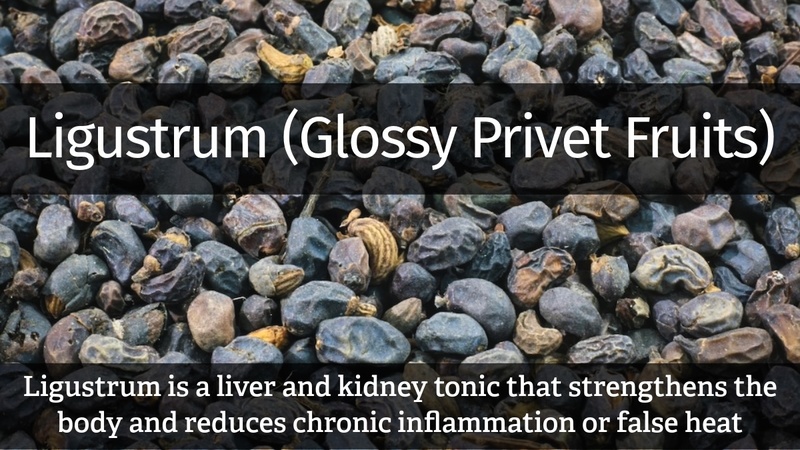
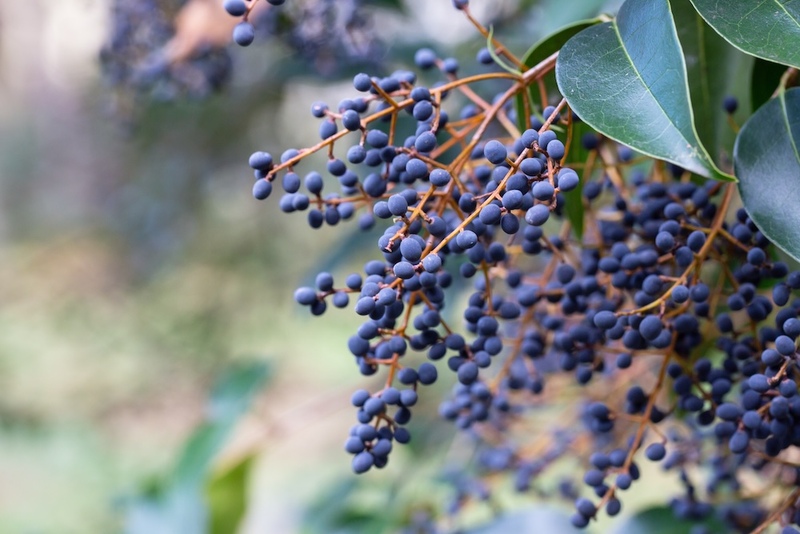
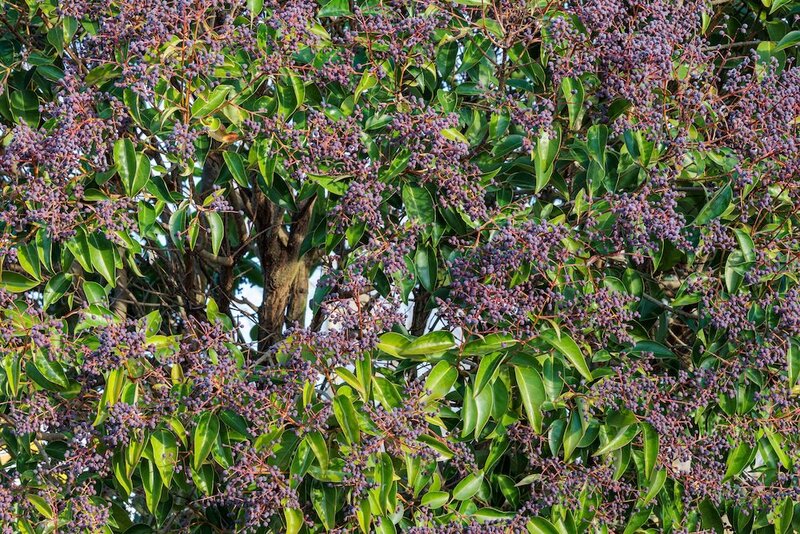
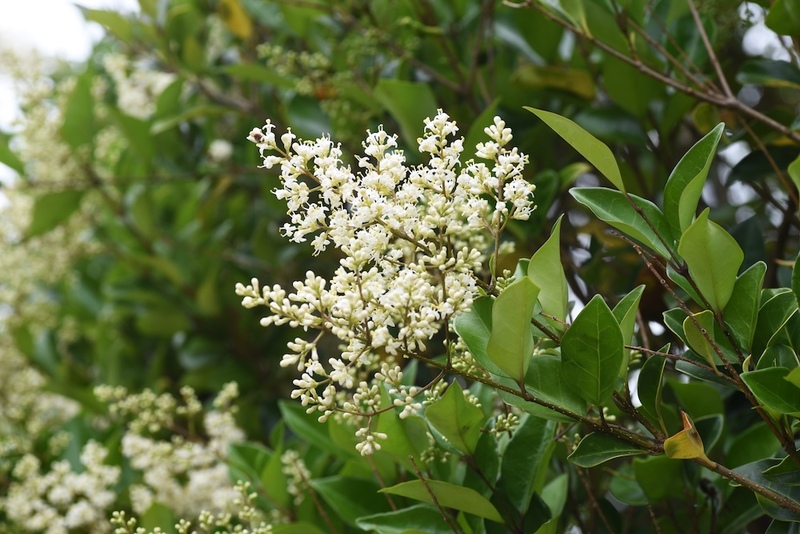
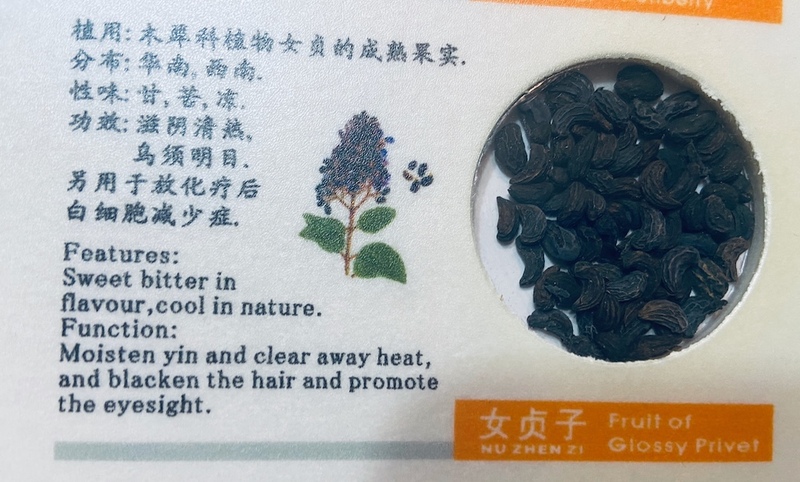
Privets are part of the genus Ligustrum and are widely grown as ornamental shrubs or trees, with some being used to create hedges. Many species produce fruits that are eaten by birds but are toxic to humans. I found a small privet tree on the property my wife and I moved to last fall, but because I can’t confirm it’s the correct species, I’m not going to mess with harvesting the fruits. However, there is one species, Ligustrum lucidum, also known as glossy privet, which produces fruits that are used in traditional Chinese medicine (TCM).
Ligustrum (glossy privet) fruits are used in TCM to tonify the liver and kidney energy. The flavor is sweet and bitter with a cooling effect. They are also used to tonify the jing, which is the basic life energy residing in the kidney-adrenal area. This means they are used, typically in combination with other herbs, to counteract problems like premature greying of the hair and dizziness. They're also used to aid the eyes and reduce yin-deficient heat. To understand how they can be used to promote health, let's first look at some of these TCM concepts, starting with false or yin-deficient heat.
Yin Deficient Heat
 In Western herbalism, we're very familiar with the concept of anti-inflammatories. Traditionally, anti-inflammatories were thought of as cooling herbs that reduced heat. But there is a difference between what is needed to reduce acute inflammation and fever, as seen with acute injuries or infections, and what is needed to correct chronic inflammation, which is associated with chronic illness and aging.
Think of it this way. Heat is associated with energy, which in TCM is connected to the yang energy. You can have too much yang energy, creating symptoms of heat. However, you can also get the appearance of heat if there is too little yin energy in the body. The body is not overheated, per se, but appears that way because the balancing, cooling yin-energies are deficient. This is called false heat, and it is this type of heat that ligustrum addresses.
I first learned about the concept of false heat from a class I took on tongue analysis taught by my fellow herbalist and friend, Matthew Wood. Acute inflammation manifests on the tongue as a bright red color. The tongue is usually pointy as well. False heat, on the other hand, shows as a dark red or purplish color to the tongue. The former is acute heat (or excess yang), while the latter is subacute or chronic heat (deficient yin).
Heat and Electrical Energy
 To understand this better, let's look at how the body responds to an injury. Let’s say you get hit hard, and the blow raises a painful red welt on your body. The redness and acute pain are symptoms of acute inflammation, the body’s initial response to injury. If you treat the injury properly at this point, the tissues may return to normal fairly quickly, but if the injury doesn’t fully heal, the red welt becomes a black and blue-colored bruise. It's the same difference with the bright red, versus the dark red, purplish tongue.
I gained further understanding of this from Jerry Tennant's book, Healing is Voltage. He explains that in acute inflammation, the activity of the tissues increases, which is reflected by an increased (more alkaline) pH. The pH of a substance is determined by how much electrical energy there is. Protons have a positive charge and electrons have a negative charge. The more electrons present, the more alkaline the pH, and the more potential electrical energy there is. The more acidic the pH, the more electrons are lacking and the lower the energy potential becomes.
So, one can have heat from excess energy, but one can also have the appearance of heat from deficient alkalinity. In one, you calm the energy down the electrical activity, while in the other, you need to nourish or build the energy potential. I came to realize that this directly relates to the concept of antioxidants and free radicals.
Free Radicals and Antioxidants
 Over the years, I've read a lot about oxidative damage from free radicals as a cause of aging and degenerative disease. This is related to electrical activity and pH. To put it simply, free radicals (also known as oxidants) are molecules that are missing electrons. In the attempt to stabilize their electrical charge, they steal electrons from other molecules. Antioxidants, on the other hand, neutralize these free radicals by donating electrons to them.
This directly relates to electrical activity and pH. A battery works because one side of the battery is acidic and the other side is alkaline. When the two sides are connected to form a circuit, electrons flow from the alkaline side to the acid side. This is the same process as antioxidants, moving electrons to neutralize free radicals. Thus, if alkaline reserves are low, tissue irritation will be present simply because there isn't enough antioxidant power to keep the system from overheating. This is one way to explain the benefit of an herb like ligustrum. It has antioxidant properties that help cool the body by neutralizing free radical activity.
Antioxidants and the Liver
As evidence of this idea, let's also look at the use of ligustrum to “brighten the eyes” in TCM. In TCM, the liver “opens the eyes,” and a lack of nourishment to the liver causes problems with the eyes, such as dry eyes, blurred vision, and redness or pain in the eyes. My understanding of this is that the liver and the eyes require the most antioxidants of all the tissues in the body. The liver produces free radicals in the process of detoxifying chemical compounds and needs antioxidants to protect it from that process. The eyes need antioxidants because light causes oxidative stress. So, if there are insufficient antioxidants in the body, both the liver and the eyes become irritated from the deficiency. These irritations are both examples of yin-deficient heat.
Other Causes of Yin-Deficient Heat
 Moisture is also associated with yin. So dehydration can be another cause of yin-deficient heat. I’ve experienced this when I’ve been out in the sun and haven’t consumed enough water to compensate for the loss of fluids from sweat. Pretty soon, your system starts to overheat in a process we call heat exhaustion. My theory is that dehydrated tissues can also get “heat exhaustion” or signs of irritation (heat) from the lack of fluids. As a kidney tonic, ligustrum also helps preserve fluids and moisten tissues. In other words, it helps moisten tissues.
Another cause of yin-deficient heat is chronic stress. The adrenal glands produce cortisol, which controls inflammation in the body. If the adrenal glands become depleted by stress, a person experiences burnout, which can often involve irritation associated with weakness, such as severe fatigue coupled with difficulty sleeping due to high levels of anxiety. As a jing tonic, ligustrum helps tonify the basic life energy in the adrenal glands.
Using Ligustrum
Like many Chinese herbs, I’m not familiar with ligustrum as a single remedy. It is part of three formulas I’ve regularly used. It’s part of the Water-Increasing Formula, which tonifies the kidney, and the Wood -ncreasing Formula, which tonifies the liver. It’s also part of a Qi and Blood Tonic Formula, which I’ve used for deficient conditions where a person is weak and/or wasting. This formula is also a good tonic for people who are undergoing chemotherapy and radiation treatments. This matches one of the specific uses for ligustrum in TCM. It is part of the Fu Zheng therapy, where it is combined with herbs like astragalus and ganoderma to help reduce side effects of chemotherapy and radiation treatments.
If you do try ligustrum as a single remedy, the recommended dosage is 10-15 grams in a decoction, paste, or pill form. The unprocessed herb is better at moistening tissues, while the processed herb (steamed with grain alcohol) is better as a liver and kidney tonic.
Steven's Articles
May
-

-
The Health Benefits of Cruciferous Root Vegetables
Radishes, turnips, and rutabagas aid detoxification,…
-

-
Watercress, Garden Cress, and Pennycress
Three valuable overlooked cruciferous vegetables…
-

-
Cruciferous Vegetables
The Health Benefits of Broccoli, Cauliflower,…
April
-

-
Kale Chips
A fun way to eat your leafy, green vegetables
-

-
Ligustrum (Glossy Privet Fruits)
Ligustrum is a liver and kidney tonic that strengthens…
-

-
Bupleurum
An important Chinese herb for supporting the liver…
March
-

-
N-Acetylcysteine
An amino acid-based supplement for liver, eye,…
-

-
The Effects of Tryptophan on Health and Mood
L-Tryptophan and 5-HTP are important precursors…
-

-
The Exotic Scent of Ylang Ylang
Promoting sensual feelings, relaxing the nerves,…
-

-
The Uplifting Fragrance of Jasmine
Jasmine lifts depression, aids self-confidence,…
February
-

-
Reishi (Ganoderma) Mushroom
A TCM remedy for calming the shen (spirit), balancing…
-

-
Eucommia Bark
A superior tonic that promotes kidney, structural,…
January
-

-
Goldenthread, Phellodendron, and Yellow Root
Three herbal remedies containing the infection-fighting…
-

-
Teasel
A traditional herb for healing bones and joints…
-

-
Barberry and Healthy Personal Boundaries
A thorny shrub for fighting infections and supporting…
Steven Horne is an herbalist and healer who focuses on teaching others how they can start building health and stop treating disease.
-
-
The Health Benefits of Cruciferous Root Vegetables
Radishes, turnips, and rutabagas aid detoxification,… | May 25, 2026
-
-
-
Watercress, Garden Cress, and Pennycress
Three valuable overlooked cruciferous vegetables with… | May 18, 2026
-
-
-
Cruciferous Vegetables
The Health Benefits of Broccoli, Cauliflower, Kale,… | May 6, 2026
-
-
-
Kale Chips
A fun way to eat your leafy, green vegetables | April 30, 2026
-
-
-
Ligustrum (Glossy Privet Fruits)
Ligustrum is a liver and kidney tonic that strengthens… | April 28, 2026
-
- More Articles
- Using Foods as MedicinesMay 2026Member webinar
- The Medicinal Kit in Your Kitchen CabinetJune 30, 2026 6:00 pm MTMember webinar
- Herbs & HomeopathyJuly 28, 2026 6:00 pm MTMember webinar
- The Amazing Benefits of AdaptogensAugust 25, 2026 6:00 pm MTMember webinar
- Silicon: The Overlooked NutrientSeptember 29, 2026 6:00 pm MTMember webinar
- More Webinars & Classes
Useful Links
Contact Us
Email: treelite@treelite.com
Steven Horne Creations
PO Box 1172
St. George, UT 84771
2026 © Steven Horne Creations, LLC. All Rights Reserved.